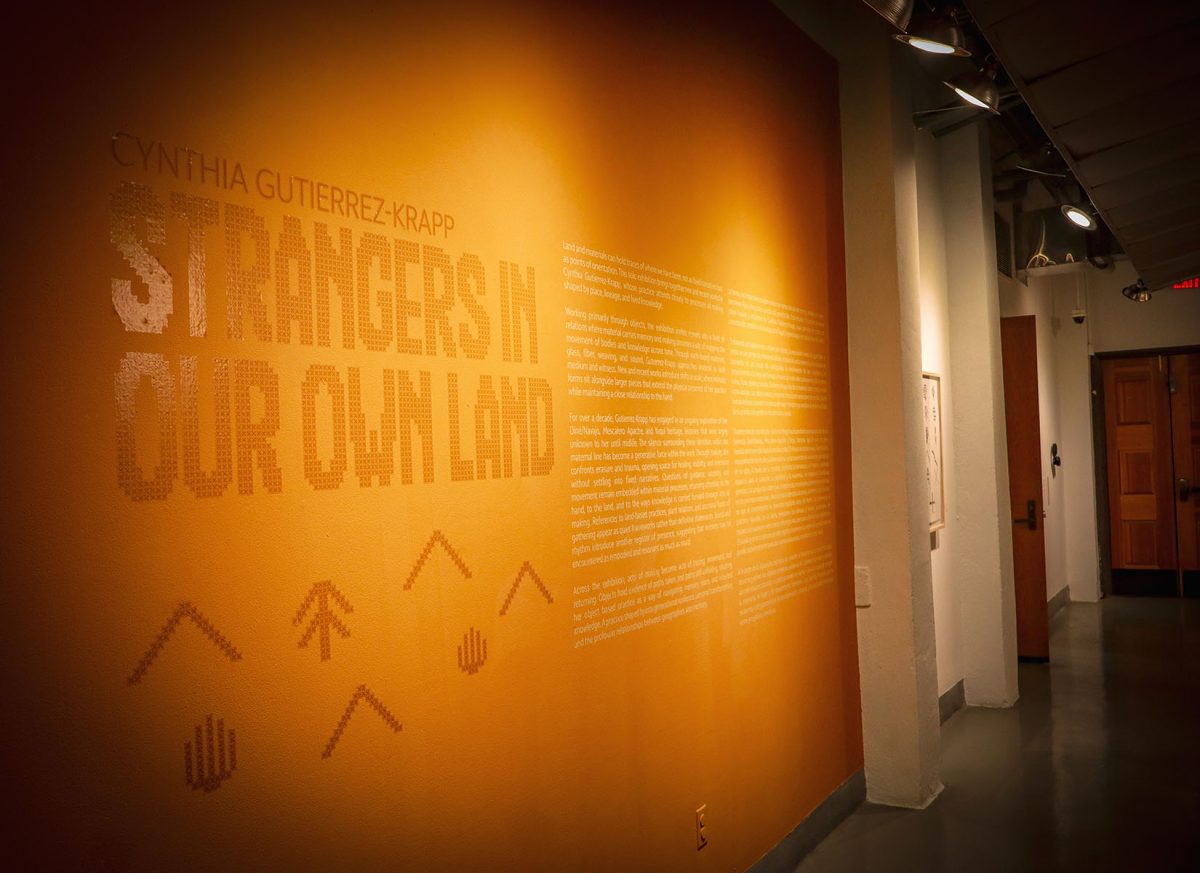

“Strangers in Our Own Land,” a new exhibition by artist Cynthia Gutierrez-Krapp at the Stanlee and Gerald Rubin Center for the Visual Arts at the University of Texas at El Paso (UTEP), opened on Feb. 19. It explores Indigenous identity, migration, erasure through large-scale beadwork, clay installations and sound.
Curated by senior curator Andres Payan Estrada, the exhibition centers on Gutierrez-Krapp’s Diné, Navajo, Mescalero Apache and Yaqui heritage, weaving together personal history and broader Borderland narratives. The show uses sound and space to reconcile the past with the present, grappling with uprootedness, inherited history and the struggle for identity in a region shaped by migration.
For Payan Estrada, who began his role at the Rubin Center in June 2025, working on the exhibition felt deeply personal. As someone from the region, he said the project resonated beyond institutional programming.
“A large part of it is an exploration of her own identity,” Payan Estrada said. “It’s rooted in reclamation bringing back narratives that are core to who she is and really at the core of who our community here in El Paso is, too.”
The title “Strangers in Our Own Land” reflects the duality of belonging and displacement. Payan Estrada described it as the tension of being tied to a place that has historically and culturally been made to feel like an outsider.
The exhibition’s inspiration was sparked after Gutierrez-Krapp and her family returned to El Paso from New York following her father’s death. She felt called to reflect on her ancestry and Indigenous migration routes in the region.
“I truly feel that I was told to do this by my ancestors,” Gutierrez-Krapp said. “It was something that I felt that I had to do.”
Themes of erasure and forced assimilation run throughout the exhibition. With references to colonization, border control and the disruption of Indigenous migration patterns. Gutierrez-Krapp hopes viewers begin asking questions about their own family history.
“I would hope that people would start to look into their own ancestry and embrace their indigeneity from being part of these lands,” Gutierrez-Krapp said.
One of the central pieces in the exhibition is a large clay installation composed of more than 1,800 handmade beads that took five years to complete. Each bead was cut, shaped, fired and painted to resemble the topography of the land when viewed above. The physical labor mirrors the conceptual weight of the piece, mapping Indigenous migration routes across the Rio Grande region.
“I wanted it to look like if you’re looking from the airplane down, you can see the discolorations in the land,” Gutierrez-Krapp said. “It was a long process. It almost felt like a struggle.”
Another prominent work “Spiderwoman Told Me” extends the search for wholeness through Navajo weaving traditions and storytelling, a practice the artist grounds in a single resonant bead. Weaving symbolizes the act of gathering fragments into a unified whole and draws from Navajo weaving traditions and storytelling.
“It’s like taking all the pieces and thoughts and just weaving them together, then it becomes a story.” Gutierrez-Krapp said.
Storytelling is central not only to the artwork but also to its presentation. Payan Estrada emphasized that storytelling allows Indigenous traditions to evolve and adapt over time while remaining rooted in heritage.
“As the story moves through time, it changes and adapts,” Estrada said. “That’s a way heritage and connection to land continue to shape who we are.”
Gutierrez-Krapp also sees the exhibition extending beyond art into an act of resistance.
“Once we take that back, what we ate, where we’re from, who we are, that is a form of resistance and strength.” Gutierrez-Krapp said.
For Gutierrez-Krapp, completing the exhibition marked a personal milestone. After undergoing cancer treatment for two years, she finished her final infusion in August 2025 and immediately felt renewed energy to complete the show.
“It was perfect timing,” Gutierrez-Krapp said. “I kind of rebuilt energy to get this done.”
Both Gutierrez-Krapp and Payan Estrada hope the exhibition encourages UTEP students to see art beyond traditional forms and reflect on their own identities. The show invites viewers to consider the borderland not as an empty desert but as a site of deep history, migration and survival.
“We see beauty in it [the desert landscape],” Gutierrez-Krapp said. “I want people to see that within themselves.”
The exhibition is accompanied by public programming, including artist conversations and storytelling events, further expanding dialogue around Indigenous histories in the region.
Gutierrez-Krapp hopes it will travel beyond El Paso, carrying its message of remembrance and pride to broader audiences. For now, she hopes visitors leave with a renewed sense of belonging and perhaps fewer questions about where they are “really” from.
“Just really look at the key, the legend,” she said. “Maybe think about what your ancestors had, where they came from. Create a story, draw it out, just tell your story.”
As the exhibition continues through July 25, Gutierrez-Krapp hopes audiences take time to reflect on their own histories and connections to the region.
Fred Kepfield is a contributor writer for The Prospector and may be reached at [email protected]