Sports can unite through common elements: the play itself, the pursuit of victory and the loyal fans behind it. The connection is clearest between fútbol, or soccer, and American football—sports that share a name, separated by an ocean and a language, but built on the same love of the game.
Fútbol is the ancestor of what we now consider modern-day football, as well as the game of soccer known today. According to Under Armour, the version of American football that we now recognize was derived from practices, yet, one common oversight among fans of each sport is how much common ground the two games have.
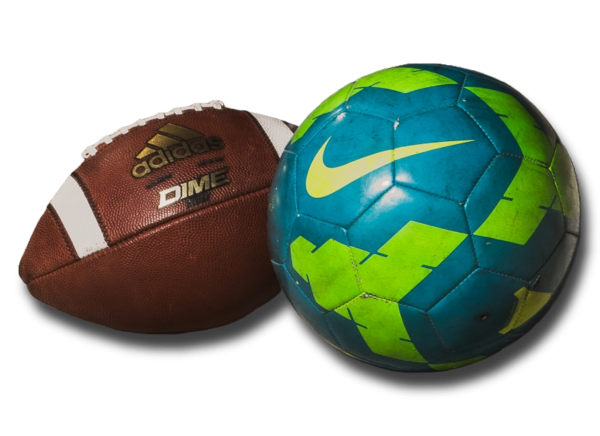
For many, the introduction to sports isn’t a choice but a tradition. For Eli Watkins, 28, it did not begin on a field, but in a living room, where the glow of a television and the voices of family made football feel less like a pastime and more like a rite.
“The possibilities in football are endless, where soccer is much more akin to a chess match with only a couple of exciting moments in an hour of a game,” Watkins said.
This isn’t a mere preference for Watkins; it’s conditioning. The American sporting mind, tuned from childhood to the drumbeat of collisions and commercial breaks, learns early what kind of noise to crave. It’s a quiet inheritance, an unspoken rhythm that hums beneath the culture, whispering what kind of spectacle deserves to be watched and when to cheer.
Some of the culture surrounding American football is one deeply conscious of consumerism, a game structured around pauses, breaks and the lucrative cadence of commercial time.
“Americans always have and most likely will always lean towards sports or games that involve danger,” Watkins said. “My point being is that at the end of the day, America’s media will never push soccer because there are no breaks in soccer meaning less money to be made overall.”
Where the foundation is constant and the rummaging of feet never ceases, from a football field to a pitch, the spirit of play endures, even if the rhythm differs.
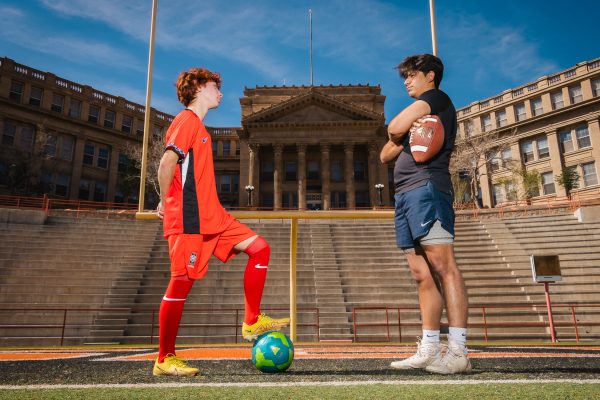
Soccer, simultaneously known as “fútbol” in many countries, has been an enduring sport for thousands of years. According to Red Bull, its earliest forms and variations were practiced in ancient China, Greece and Rome, with the modern, standardized version taking shape in the 19th century following the formation of the Football Association in London.
From youth leagues to the TV screen, Devin Kastenschmidt’s eyes and feet have never left the ball, playing then, watching now. Though soccer sits at the forefront of Kastenschmidt’s passion, the pull of football is undeniable. He proudly follows Chelsea F.C. on the pitch and the Packers on the gridiron.
Tradition resonates in both sound and sight, as Kastenschmidt notes with the Chuco Blues, Chelsea’s El Paso fan club. From the echoing chant of “Blue is the Color,” the team’s anthem, to fans proudly adorned in jerseys, scarves and team colors, the passion is visible and audible.

“I think it’s cool watching and hearing soccer teams’ chants and songs, then if you watch NFL games, fans make as much noise as possible,” Kastenschmidt said. “It’s different, but the intention of support is the same.”
For Kastenschmidt, the highest form of sportsmanship is neutrality, appreciating a game for its skill, strategy and tradition, rather than rooting solely for one side.
“I believe you have to try new things to form an opinion on different sports. Everyone is different, same with sports,” Kastenschmidt said. “I think there’s a lot of passionate support from people and their teams. Both my teams celebrate their histories and traditions in unique and varying ways.”
Fandom, though exclusive, is inclusive in demeanor; creating a rapport among all sports. Despite a divide among sports, and at times among teams, the adoration and the need to showcase it is universal.
Jazmine Gracia is a writing contributor The Prospector and can be reached at [email protected]